Author Archives: stompboxproject

Diode Analysis

Today I have carried out a simple electrical analysis on 5 different diodes in order to provide some investigative research for this project, comparing forward voltage (the voltage across the diode) to forward current (the inherent current found to be flowing through the circuit). The 5 diodes tested and their respective forward voltages via datasheet information were as follows:

0A47 ( Germanium Signal Diode) – 0.4V

1N4001 (Silicon Signal Diode) – 1.1V

1N4148 – (Silicon Switching Diode) – 1V

1N 5402 (Silicon Rectifier Diode) – 1.1V

SW08PCN030 (Silicon Schottky Diode) – 0.9V

To do this I used a small piece of veroboard to create a circuit where the diode under testing was in series with a 20Ω resistor for some current limiting, a short length of multicore cable was added at each end for DC voltage input from a SkyTronic DC Power Supply. In order to monitor the voltage more precisely a multimeter was placed across these terminals, for measuring current an identical multimeter was placed in series with the circuit. The circuit diagram and photographic evidence shown below should help to reinforce this information:

To create a good graphical representation of this data I incremented the voltage in 0.1V steps up to 1.5V where each diode should have reached its linear stage, noting the current with each increase. The line graph below shows the result of this investigation:

From this graph the forward voltage of each diode can be identified by the onset of a linear response present after ≈1V on each line,  the slight disruption in linearity is nothing but an anomaly and may be caused by temperature change, instrument calibration issues or component inaccuracies. The other interesting point to note is the presence of current before the diodes reach their forward voltages, widely known as leakage current.  the Germanium 0A47 demonstrates an exponential passage of current far below its Vf of 0.4V as opposed to the Silicon 1N4148 which progresses into its linear region much more quickly.

When applied in a clipping circuit, during the transition between blocking and passing signal (0V – 0.4V), the Germanium diode will shunt an increasing amount of the signal current to ground which is directly proportional to the voltage. This is true up until the forward voltage is reached when all current is shunted to ground, ‘soft clipping’ is born as a result of these two occurrences combined, hard clipping comes as a result of a much shorter transition from blocking to passing as can be seen, though in varying amounts, in the other four diodes.

Each complete diode model carries its own transient characteristic and current leakage properties, a change in semiconductor material, insulating material, doping techniques, physical size or any other contributing factor will have an effect on said characteristics due to the diode’s very simplistic construction. The investigation which I carried out today identifies these differences using simple electrical measurements and will provide some groundwork for explaining the subsequent tonal differences.

Tagged , , , , ,

Combined Clipping Circuit v1.0

Following my successful investigation into the common methods of clipping a guitar signal I have created a schematic around which I will base the rest of the circuit, a screenshot of this is shown below.


The idea of this is to create many different combinations of Diode & MOSFET clipping, each of the Single Pole Single Throw (SPST) switches represents a single pole of what will be an 8 pole DIP switch unit and the Single Pole Double Throw (SPDT) switches will either be a push button or rocker style switch. Both of these will be labeled and accessible on the front panel of the product, the 20kΩ potentiometer used to control the gain will also protrude from the casing with a dial for easy modification.

Circuit Explanation

Upon the signal entering the it immediately encounters a SPDT switch which gives the user the option of selecting C3 or C5 in combination with R6 for use as a first order high pass filter, the cut off frequencies of which are determined by:

1/(2 x π x 0.00000000068 x 1000000) ≈ 234Hz

1/(2 x π x 0.00000002 x 1000000) ≈ 80Hz

This option was implemented in order to stop any frequencies below this from becoming distorted, whether the final sound improves or deteriorates as a result can vary depending upon the musical context and extent of the clipping or overdrive. The 1MΩ resistor in parallel with the op amps non-inverting input dictates a high input impedance, D3 & D4 represent a BZB984 dual Zener diode regulator which provides over-voltage protection of 10V. The signal then enters the TL072 through the non-inverting input, the resistors in feedback loop determine the overall gain where potentiometer R3 can be altered to vary the gain between 1 and 21. After the build of my prototype I realised that a gain of 11 just wasn’t  adequate for some styles of music, the equation below shows how I calculated this gain:

Max Gain = (20000/1000) + 1 = 21

Min Gain = (0/1) + 1 = 1

A low pass filter made optional by J15 is formed by R5 & C4, attenuating frequencies above  3386Hz by 3dB/octave which was recommended by Sonthheimer, R. (1998) in order to ensure that the resultant sound is not “too aggressive”. The equation i used to define this cut off frequency is:

1/(2 x π x 0.0000000047 x 1000) ≈ 3386Hz

J11 & J12 enable symmetrical or asymmetrical clipping of the  feedback signal, these are germanium 0A47 diodes for soft and subtle clipping. As mentioned above, these switches, alongside J1 – J6, represent a single pole of a dip switch and when used in different combinations will provide a wide variety of clipping effects.

D1,D2,D5 & D6 are silicon 1N4148 diodes, symmetrical or asymmetrical clipping can be achieved via J1 & J2 and D6 can be bypassed via J7 to provide a lower forward voltage and thus more clipping.

D10 – 13 are TO-220 Schottky diodes with a forward voltage of 0.38V, this will produce a harsher clipping perfect for genres such as thrash metal when combined with enough gain. A/symmetrical and bypass switches have been applied as in the germanium diode sub circuits.

J5 & J6 give access to clipping via single or dual IRF510 MOSFET’s, J10 can be altered to replace the second MOSFET body diode with an 0A47.

J13 is a bypass switch, routing the unmodified signal to the output.

Below are the resultant waveforms for each type of clipping, upon inspection it becomes apparent that  the ability to mix and match these different types will prove to be invaluable.

Symmetrical 0A47 Feedback Clip

Asymmetrical Single Diode Clip

Asymmetrical Dual Diode Clip

Asymmetrical Single Schottky Clip

Asymmetrical Dual Schottky Clip

Asmmetrical Single MOSFET Clip

MOSFET / MOSFET + Diode Clip

In retrospect of this recent progress I feel that attempting to design and create a distortion pedal encasement which can withstand the weight of a human and house enough physical interfaces to be one of the most malleable analogue distortion pedals in existance is a very tall order for the time scale in place. For this reason I have succumbed to the idea that, although a contradiction to the blog title, the final practical piece will be a standalone effects unit rather than a ‘pedal’. I feel that this is the best practical solution given the circumstances and will save two of my most precious resources, time and money.

References

Sonthheimer, R. (1998) Designing Audio Circuits. Dorchester: Elektor Electronics pp. 168

Tagged , , , , ,

Improved Analysis of Electric Guitar Signals

Upon looking back at the previous spectral analysis of a guitar signal I realised that this was not much use, as such I decided to carry out the investigation again in order to gain a more useful result.

The spectrogram view in a digital audio editor called Audacity© was used to carry out an investigation on the frequency content of the electric guitar, using a USB audio interface one shot notes and chords were recorded and saved into individual mono tracks. A Hanning window was used with 32768 point Fast Fourier Transform (FFT), adding 50dB gain and reducing the range to 40dB gave an ideal spectrogram showing each individual harmonic and the order in which they fade following the initial impact.

The outcome of this investigation can be found in the screenshots below where the vertical axis represents a logarithmic frequency scale and the horizontal represents time in seconds.

E2 (Hanning, 50dB Gain, 40dB Range, 60 - 3kHz)

C#6 Spectogram (Hanning, 50dB Gain, 40dB Range, 500Hz - 15kHz

Open E2 Chord (Hanning, 50dB Gain, 40dB Range, 60 - 4kHz)

The E2 spectogram proves the fact that a lower frequency entails a longer fade out time or sustain, the fundamental got to an inaudible level after around 30s whilst the 10th harmonic faded after just 3s. Shelquist (2011) states that “Each open string vibrates at a frequency which is directly proportional to the strings tension”, from this a conclusion can be made that the E2 string will have a lower tension and therefore less vibrational inertia.

The C#6 portrays a similar pattern but also, as the 21st fret of the E4 string, it contains far fewer harmonics and sustains for just four seconds. The impact frequencies surrounding the fundamental and first harmonic are much more pronounced in this case. In the E2 chord spectogram the short time delay between each string impact is perceivable from low to high frequencies up to 0.5s, the blue areas indicate impact noise and far higher number of harmonics as a result of the combined string displacements.

Tagged ,

A Short Analysis of Electric Guitar Signals

The purpose of today was to use an oscilloscope and EAW Smaart Acoustic Tools in order to investigate the voltage and frequency properties of a standard electric guitar signal. Firstly, to analyse the output voltages I used a modified cable with a 1/4″ jack on one end and bare terminals on the other, as shown below, to route the signal from my guitar into a digital oscilloscope.

I experimented with many different guitar styles in an attempt to discover the positive and negative output voltage extremes, I found that they could range anywhere from ±50mV to ±400mV peak dependant upon how hard the strings were plucked. One might assume that a higher note, and thus higher frequency of vibration, would induce a larger voltage due to the increased velocity. This is not so as a result of the reduced displacement of the string with increase in frequency and it would appear, through my investigation and as stated by Tillman (2002), that the two are inversely proportional and effectively cancel each other out.

The image above shows the waveform of an E major chord with ±100mV peaks, this is all well and good although I realise through my own experience, and after reading articles by Till (2002) and Lemme (2009), that the voltage output of an electric guitar can differ greatly as a result of these main characteristics:

  • Varying techniques involved with coiling and noise rejection
  • Physical shape of the magnet, the sensing area of which is known as the ‘Magnetic Aperture’
  • Position of the magnet relative to the strings and/or guitar body
  • Differing resonances at the output as a result of the complete circuit consisting of the pickups, tone/volume controls and external load
  • Active electronics which boost the signal and normally include tone/timbre modifying circuits
  • Parasitic capacitance in poorly designed cables
Considering this information I realise that the input stage will need to be able to accommodate a large range of voltages, a limiter created by opposing Zener diodes in series, as suggested by Sonthheimer (1998), and an appropriately variable gain control in the region of 1 to 30 should account for these needs.
To carry out an investigation on the frequency content of an electric guitar I used EAW’s Smaart Acoustic Tools, using a USB preamplifier I recorded one shot notes and chords saved in the .wav format for the software to analyse in the form of FFT and spectrograph’s. The images below indicate that harmonics up to and beyond 20kHz exist  by playing chords rather than single notes leading to a requirement for the full auditory spectrum to be passed through. However, as Sonthheimer (1998) states, ” Without (any) high frequency attenuation, the guitar would sound very scratchy when it is played in conjunction with a distortion unit”. This comes as a result of the amplified harmonics which I intend to reduce through filtering alongside frequencies below 150Hz, this will deteriorate the guitars natural tone but attenuating these frequencies will hopefully give a much more pleasant auditory experience.
E major Open Chord 
Partial D major Chord 
Low D (6th String Dropped by 2 Semitones)
High D (1st String, 21st Fret)
References

Tillman, J.D. (2002) Response Effects of Guitar Pickup Position and Width. Till.com [Online] [Accessed 06/02/2012] Available at: http://www.till.com/articles/PickupResponse/

Lemme, H.E.W. (2009) The Secrets of Electric Guitar Pickups. Build Your Guitar [Online] [Accessed 06/02/2012] Available at: http://buildyourguitar.com/resources/lemme/

Sonthheimer, R. (1998) Designing Audio Circuits. Dorchester: Elektor Electronics pp. 109,110

Signal Clipping Prototypes 3

My task for today was to replace the clipping diode/s with IRF510 MOSFET’s to check their audible effect, I did so in accordance with the veroboard layout posted in the first section. The resultant circuit is shown below:

Upon testing the circuit I found that there was an extraordinary amount of noise present at the output, after browsing for dry or over zealous soldering joints and checking each part of the circuit with an oscilloscope probe I decided that the most likely cause was high levels of EMI in the area. This is unavoidable in these kind of environments due to the abundance of  electronic equipment in the form of high voltage transformers, power supplies, WiFi transmitters and computer servers amongst many others. In an attempt to better this I replaced the input and output cables with a length of screened multicore, using one of the ways for signal transfer and the screen for EMI shielding by connecting it to ground in each case.

Much to my dismay there was relatively no change in noise levels, upon further inspection of the circuit’s solder side I noticed a minute piece of solder bridging from the op amp’s positive power supply input to the signal output. Correcting this with a soldering iron completely solved the problem, sending a 1kHz 200mV pk signal to the input gave the waveform shown below when using just a single MOSFET to create soft asymettrical clipping.

When using my guitar as an input to the op amp the soft clipping and subsequent limited harmonics gave rise to an distortion tone not dissimilar to that created by an overdriven valve amplifier, a warm fuzzy distortion the likes of which are very popular in genres such as blues. Using the body diodes of two MOSFET’s to create symmetrical clipping gave a more aggressive but equally pleasant tone. Through this investigation I have gained invaluable knowledge with regards to what will be included in my final circuit design, despite the difficulties encountered the circuit and its coinciding effect on the signal exceeded my expectations.

Signal Clipping Prototypes 2

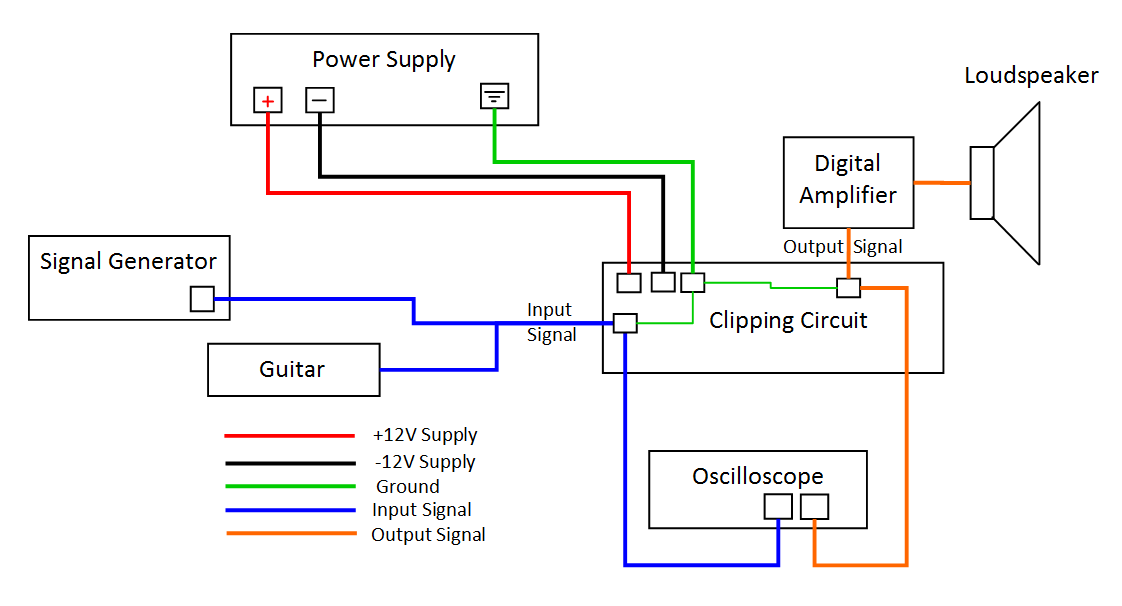
In order to carry out a basic electrical test on my clipping circuit I used the power supply, signal generator oscilloscope in Ms130. The way in which this equipment was applied is illustrated in the block diagram below:

I also acquired a “Flying Mole M100” digital amplifier and a “Gale Mini Monitor Mk2” to ensure that the audible output was of adequate quality, to carry the signal from the circuit’s bare wire output into the amplifier I used a dual banana plug to 3 pin XLR cable (where only pins 2 & 3 were connected) and standard two pole speaker cable to pass the sound to the loudspeaker inputs. The images below should help the reader to understand this unavoidably confusing terminology:

To check what the circuit was achieving in terms of clipping I set the signal generator to produce  a 200Hz, 300mV p-p sine wave ,which is very close to a  G3 note and presents a typical output voltage for passive guitars, the image below shows the resultant oscilloscope reading where the input and output signals can easily be identified by their inherent waveforms.

From this oscilloscope reading it can be seen that the circuit is not just clipping the signal but actually depleting it altogether following a 50mV rise and fall, leaving only a small section of the original sine wave in place. At this point in time I am unsure as to why this is the case although upon routing my guitar to the signal input using a modified cable I found that it gave a fairly conventional level of distortion with some nice harmonics.

The high noise floor, which I measured to be approximately 50mV, is as a result of the low cost op amp and can clearly be seen here. What I did notice that isn’t obvious from the above image is that voltage spikes of up to 100mV would appear randomly throughout, when using the guitar as an input signal this would lead to undesirable ‘pops’ in the distortion which I can only assume was derived from the op amp too.

Upon turning the potentiometer I realised that it had absolutely no effect on the output signal, which was very suspect considering that it should effectively control the gain from 1 to 10. After a short while I realised that I had connected the second terminal of the resistor to ground rather than the conventional ‘wiper’, meaning that the resistance was held at 10kΩ irrespective of wiper position. After correcting this by moving the corresponding jumper wire the potentiometer had a dramatic effect on the output, increasing gain and thus distortion.

What I hadn’t realised until this point was that the decoupling capacitor and feedback resistors were combining to form a high pass RC filter, meaning that a decrease in resistance (increase in gain) was also allowing more LF to pass through. This vastly improved the phonic properties by adding a little more crunch to the tone, this variation would be very useful to control in the final design although not necessarily at the same time.  Part of the resultant waveforms and their approximate resistor values are shown below where a higher gain predictably gives a faster rise time and therefore a different sound:

In order to get one step further in my search for euphonic distortion I removed one of the diodes to achieve asymmetrical clipping, this provided a cleaner, more defined sound and would mean less components prone to failure in the long run. I then replaced this single 0A47 diode with a 1N4004, this gave additional definition to the distortion and seemed to eliminate detrimental harmonics.

All in all this was an extremely productive day and the information I have gained as a result will help towards my final circuit design.

Signal Clipping Prototypes

Today I created Veroboard layouts for the Diode & MOSFET clipping circuits in order to create a prototype, these are shown below where a solid line  represents a link between tracks and a cross represents a break.

A 1:1 scale was used so these are quite compact but still entirely discernible.

Most of the components I required to build these circuits were plentiful in the Universities existing stock which saved on budget and time. However, the high quality op amp, rare diodes and MOSFET’s were not and as such I strategically chose components similar to those stated and which would be perfect for prototyping.

– The proposed Germanium 1N34A diode was replaced by a  0A47 which, according to the datasheet which I acquired from Andrew Wylie who specialists in obsolete technologies such as this, has a forward voltage of 0.65V rather than 1V. A photocopy of this datasheet and Mr Wylie’s website and email address can be found in the related resources section of this blog.

– The 1N4148 was replaced by a 1N4004 which has a forward voltage of 1V at 1mA as opposed to the 0.6V which the former would achieve. Due to a forward voltage similar to that of the germanium diode I assumed that this would  produce similar audible results but I was willing to test this fact in case of improved tonal qualities.

– The TLE2072 was replaced by a UA741 op amp, although this budget IC has a high noise floor and relatively low slew rate it stands as an acceptable alternative for prototyping.

– The IRF520 was replaced by an IRF510, the only diffrence I can find when looking at the data sheets is that the latter has a 0.5Ω Source-Drain resistance rather than 0.27Ω  and a lower forward current rating which shouldn’t make too much difference to the audio.

Using the equipment in MS130, the project room, I created the symmetrical diode clipping circuit, the image below shows the (assumably) working prototype once I had finished soldering in the components and strategically breaking the  tracks. Feeling confident about the success of this circuit, I left the lab with the intention of returning the next day to carry out some testing.

MOSFET Distortion

To re-initiate my project after the new year I have created another circuit which aims to distort the signal using MOSFET’s (Metal-Oxide Semiconductor Field-Effect Transistor).  Symmetrical clipping can be produced by using the upper MOSFET’s  gate-source junction to clip positive signals and the lower inverted MOSFET gate-source juntion to clip the negative signals, simultaneously the body diodes with 0.7V reverse bias will also clip the opposing voltage on each one and therefore creating a different level of harmonics. The switch can be altered to provide asymmetrical clipping, using only one MOSFET to provide a different clipping threshold for +ve and -ve signals.

This circuit is very similar to that of the diode clipping but, in theory, it will produce an entirely different sound due to features such as the silicon oxide insulated gate and large body substrate. The resultant circuit diagram is shown below:

The resultant waveforms for the asymmetrical clipping can be found on the ‘Images’ tab, for some reason the symmetrical clipping screenshot appeared to be identical but I doubt very much that this would be the case when carried out practically.  Fairly soon I will begin testing this circuit and the similar diode clipper to find out whether they will be viable for my final project, although as a result of these investigations I have very few doubts.

Small Signal Audio Design

At this point in time I realise that my project Gantt chart has not been adhered to as much as I would have liked, this is mainly due to the semesterisation of modules leading to an overwhelming amount of work in the past few weeks and the next few to come. However, as I should have noted in my proposal, I have fewer modules in the next semester giving more time for my project as well as the Christmas break where I will be working dusk till dawn in order to catch up.

After reading through Small Signal Audio Design by Douglas Self I gained in depth and extensive knowledge on the use of operational amplifiers in audio electronics, this information will form the majority of my literature review and I intend to consider the resultant notes shown below when designing the final product.

Small Signal Audio Design

Preface offers some generic useful information and references.

pp.3  – Non inverting voltage amplifier basics

pp.4 – For live performance applications it is normally acceptable to sacrifice noise floor for more headroom to reduce the chance of clipping, a gate would eliminate the need for this however.

pp.6 – Signal level should be brought to nominal internal level as soon as possible to minimise contamination with internal noise

pp.9/10 – Johnson noise is produced by all resistances, a table showing some values is on page 10

pp. 23 – Justification for using an NE5532 chip, the main advantages appear to be low noise and low cost which is ideal.

pp.23 – A 47ohm resistor is good to use as a load when testing noise levels.

pp.25 – Use smaller resistances for feedback arrangement, thus reducing the Johnson noise. This increases current however so be aware of what this entails.

pp.29 – More amplifiers configured with parallel inputs reduces the noise floor but increases cost.

pp.37 – PCB Track Resistance can become an issue if ignored completely

pp.39 – PCB crosstalk can be reduced by placing a placing a grounded track between for “screening” where necessary, this crosstalk may be negligible due to lack of HF content in guitar signals.

pp.41 – Isolating resistors may cause capacitance effect, use low values to avoid this.

pp.52 – Coupling or DC blocking capacitors are widely used in electronics for blacking power supply voltages. Decoupling capacitors keep supply impedance low and op amps stable.

pp.96 – BJT Op amps such as the 5532 have a lower voltage noise level

pp.97 – Slew rate of 5532 is 9V/µs, slew rate required for the audible spectrum at 4V is 0.5V/µs so this is very accurate.

pp.99 – Place a resistor equal to that of the feedback from negative input to ground in an attempt to eliminate DC offset

PP.118 – Analysis of the NE5532, draws more current than TL072, graph shows low noise at guitar signal frequencies for the NE5532.

pp.120 – Positive and negative rails should be decoupled with a 100nF capacitor between them, within a few millimetres of the output to stop exterior interference.

Pp. 147 – Multiple feedback bandpass filter, could be used as the tone control.

Pp.153 – Use a 10k potentiometer for pre amplification.

pp.155 – Adding a unity gain buffer means a 1k pot can be used, reducing output impedance.

pp. 158 – Using an op amp to produce an active gain control will eliminate the Johnson noise from a large pot, Vary gain from 0 to Max.

pp.158 – There is now pretty much a consensus that all audio equipment must maintain phase polarity at all inputs and outputs.

pp.219 – General volume control ideas.

pp.269 – Ambler type tone-balance control might make a perfect tone control for this project.

pp.294 – When designing the volume control, ensure bias current does not flow through potentiometer, see diagram.

pp.341 – Unbalanced input amplifier appears to have a perfect configuration and could be adapted to create the input volume also. R1 and C1 should be as close to the jack input as possible to prevent RF from emanating into the enclosure, if C1 is equal to 220pF it creates negligible attenuation at 20kHz. Since a guitar signal doesn’t come close to this a better RF rejection is a good idea.

pp.509 – Using two pairs of parallel diodes will give a ‘sharper’ clipping outcome and hence more distortion.

Diode Clipping Distortion

Last week I decided to create this diode clipping circuit using NI Multisim software, although it doesn’t give real life clipping results on the oscilliscope I now have a working design complete with power supply. I intend to build this circuit using veroboard fairly soon and get a few signal traces to analyse the output, although I will use a signal generator to provide the power supply to save some time. Below is the process I undertook to design the power supply and clipping circuit itself.

http://www.electronicspoint.com/single-supply-9v-audio-opamp-suggestions-t16481.html – Useful discussion on op amps to use with a 9V battery

http://uk.rs-online.com/web/c/?sra=oss&searchTerm=TLE2072&x=15&y=18

The outcome of this discussion was that the TLE2072 is an excellent op amp for audio use where a 9V battery is the supply.

Following this I created a power supply referring to the following website, although I did use higher value capacitors than stated to try and keep a smoother supply voltage.

http://www.generalguitargadgets.com/richardo/distortion/index.html

Multisim Circuit Simulation


The op amp is configured as a non-inverting amplifier, with R4 providing  a variable gain. The 1N4148 diodes are made from silicon with a voltage drop of 0.6V whereas the virtual diodes have been manually configured to act like germanium diodes with a voltage drop of 0.4V. Unfortunately the simulation package struggled to show the outcome of the diode clipping accurately on the oscilloscope, the corresponding screenshots can be found below. These results show a waveform very similar to a square wave, the germanium diode, due to its inherent lower forward bias voltage and small amounts of leakage current, creates a more rounded edge at the bias voltage than the silicon and cuts off at a lower voltage.

Silicon Clip


Germanium Clip

1N4148 = Silicon

1N34A = Germanium

Design a site like this with WordPress.com
Get started